


Thursday 10 February 2026
Dejan Lazić (piano)
Review by Paul Neeson (Arts Wednesday)
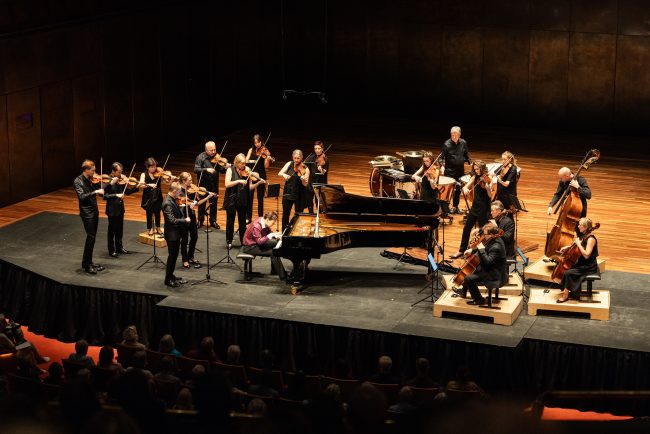
Apart from an innovative program that included both a World and an Australian premiere, lurking beneath the surface of the ACO’s season opener seemed to be a theme of migration: 3 of the four composers all left their native country to pursue their love of classical composition; maybe it has something to do with inspiration in the new, or, in Stravinsky and Rachmaninoff’s case, survival – revolution was coming in Russia.
The evening began with an ACO commission for Pulitzer Prize winning composer John Luther Adams entitled, Horizon. Adams recently emigrated to Australia and you can hear the wonder of his new world in the music. His fascination with the edge of the visible world came no doubt from a fresh and foreign landscape, one that is surrounded by water and a vast outback red centre where the horizon seems infinite as it meets an equally infinite sky. The work itself was deceptively simple, but spacious, though I’m sure the manuscript would tell another story. It started on the bass with a mesmerising chest rumbling drone that developed over time, it was the work’s bed, its foundation, almost like a didgeridoo. One by one the other strings entered the fray until the full orchestra was engaged – something special was happening. As the instruments wove and dodged and skated around its central theme, its drone like bed, it created a complex atmosphere evoking sounds of the dawn bird chorus, a vast outback landscape meditating upon the metaphysical patterns of silence and nature, against the backdrop of what might have been tantamount to a primordial hum. Conversely, perhaps its an urban awakening, the slowly rising hum of the city as it wakes, the frenzy and craziness of modern life. But then just as slowly as the strings finished their individual lines – in turn – and went silent, things went full circle until there was only the hypnotic drone of the bass left – a perfect arc! I was bewildered by how the musicians kept time, but concluded there was no tempo or rhythm, perhaps just a luscious earthy pulse. Time was measured only by the duration of each instrument’s unique music. The work conducted itself. Genius.
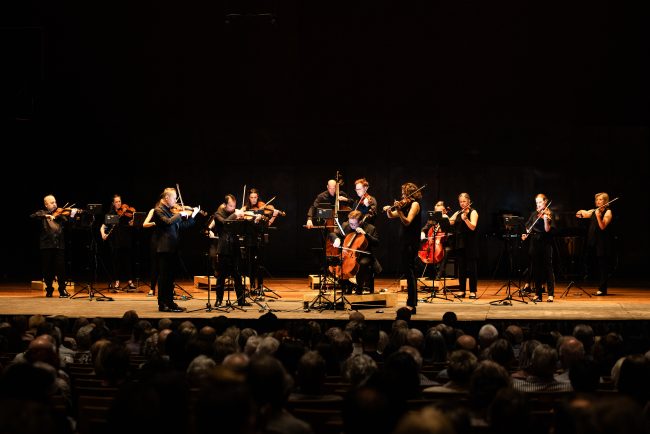
Stravinsky was next up with his Concerto in D “Basle”. He composed the work for the Basle Chamber Orchestra’s 20th birthday just after he had relocated to Hollywood (1946). The premise is similar to Bartok’s Concerto for Orchestra, in that there is no soloist and it attempts to show off the individual sections of the orchestra (string orchestra in this instance). There are many surprising sounds emanating from the various string instruments, including slaps and sharp pizzicato, lush string glissandi reminiscent of the film music of the time (it was Hollywood after all) and frenetic nervous passages that are quite disturbing, but undeniably Stravinsky.
Raminta Šerkšnyté is not a name I am familiar with but it soon became apparent why De Profundis is the most frequently performed Lithuanian composition at the concert halls of the world. As an Australian premiere, of course Richard Tognetti had to include it in the 2026 season. The mood overall was one of melancholy. A dark and cold place that teetered between quiet urgent twittering and dark despair. Only towards the end did the mood lighten and a little light shone into Šerkšnyté’s sound world. Rhythmically very complex, Tognetti did well to direct the ACO through some of the more challenging pauses and declamations. If the ACO can be relied on for one thing it is their precision, and their musical expression. Ok two things then, but of course even more than that..
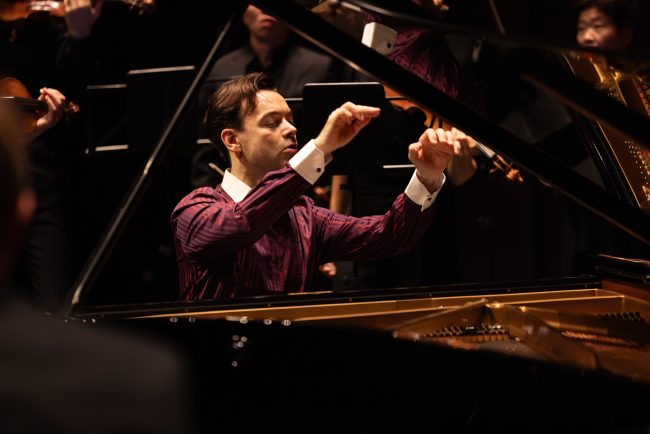
Finally Croatian-born pianist, Dejan Lazić sat before the freshly polished Steinway to perform Rachmaninoff’s Rhapsody on a Theme of Paganini. And what a technically brilliant and entertaining soloist he proved to be. For a pianist, the Rhapsody is as technically demanding as Paganini’s 24th Caprice is for a violinist, the work on which Rachmaninov based his 1934 composition while living as an expat in Switzerland (he left Russia in 1918). Tonight we heard an arrangement for piano, percussion and strings by Bernard Rofe. While it lacks the lush Rachmaninov orchestration, it instead provided a clarity of melody and thematic interaction that can get obscured with the full orchestra. Bravo to percussionist Brian Nixon who played timpani, snare drum and bells creating some interesting and surprising textures. All the elements were there from the sigh-eliciting 18th Variation, to the devil’s hint of the Dies Irae liturgical plainchant in Variations 7, 10 and 24.
And if that wasn’t enough to set the City Recital Hall aflame, Lazić delighted us with a virtuoso encore – a Bulgarian Dance from Bela Bartok’s Mikrokosmos. Rapturous applause!
The ACO like to set their devoted fans a challenge or two with the programming, but somehow we always walk away feeling like it was worth expending that energy to appreciate new music, new sensations and marvel at their musical brilliance and mastery.
You can listen to a recent interview with Dejan Lazić below where he discusses Rachmaninoff’s Rhapsody at length:
Share "Review: ACO Rachmaninoff’s Rhapsody"
Copy


