


Thursday 8 January 2026
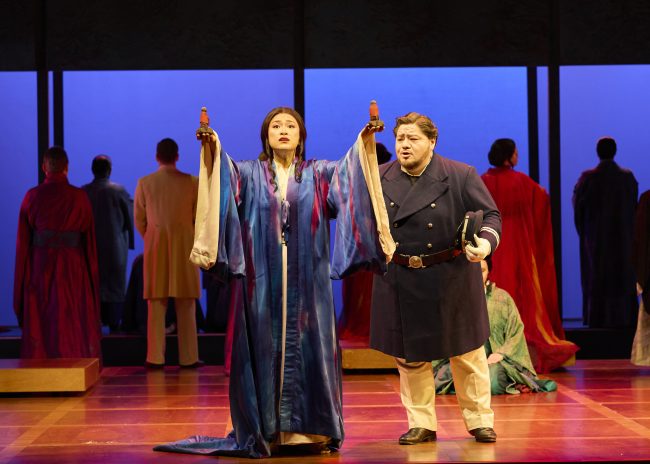
Revival and Movement Director, Matthew Barclay, brought together an incredibly talented team of creatives to reproduce Moffat Oxenbould’s 1997 award winning production of Madama Butterfly for Opera Australia’s 2026 season.
The casting of Guanqun Yu as the impressionable and innocent Cio-Cio-San was a creative masterstroke. She delivered the role with not only technical brilliance but a depth and maturity of character that carried the opera throughout the three acts – superb!
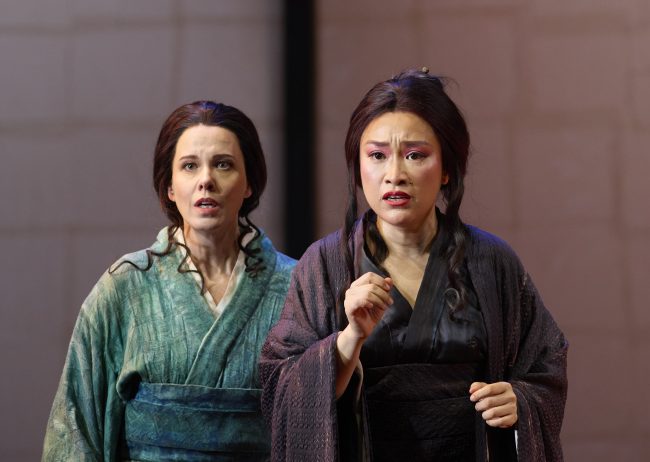
When Robert Watson had to pull out from his role as Pinkerton at the last moment, Barclay was fortunate indeed to find Diego Torre close by. He had performed the role before and his powerful tenor voice and unlikely physicality leant Pinkerton the plausible flaws that make the character more than two dimensional. The two lead performers combined into an electrifying chemistry that created a dramatic synergy, that was both spellbinding and ultimately tragic. A special mention also to Sian Sharp as Suzuki, whose mezzo-soprano was a tender foil and counterbalance to the lyrical acoustic power of Guanqun Yu.
And what a brilliant start to the tenure of Andrea Battistoni as OA Music Director who was tonight’s conductor. He expertly controlled the lush romanticism, the sweeping emotion of Puccini’s music, kept in perfect balance with the soloists and chorus.
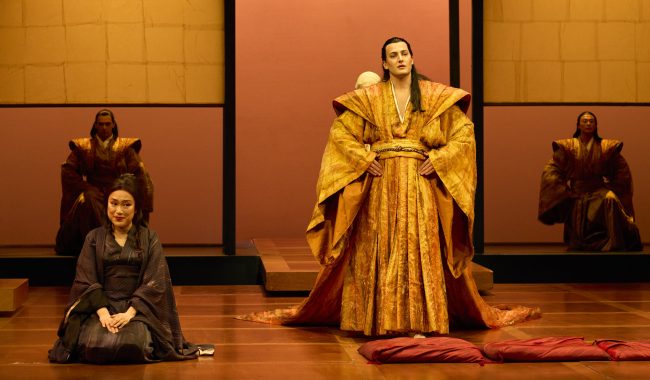
The visual magic was created by Russell Cohen and Peter England’s set and costume design, it’s what we all remember and is one of the main reasons for the revival of Oxenbould’s production: every hilltop Japanese villa needs a water feature, and this one was perfect; and there was an almost audible sigh of delight when the full moon and starry sky was revealed by the raising of the seemingly authentic but also functional Japanese screens that served many purposes in the drama. The Japanese shot silk costumes were worth the ticket price alone, in particular the robes of Bonze (David Parkin) and Prince Yamadori (Leon Vitogiannis).
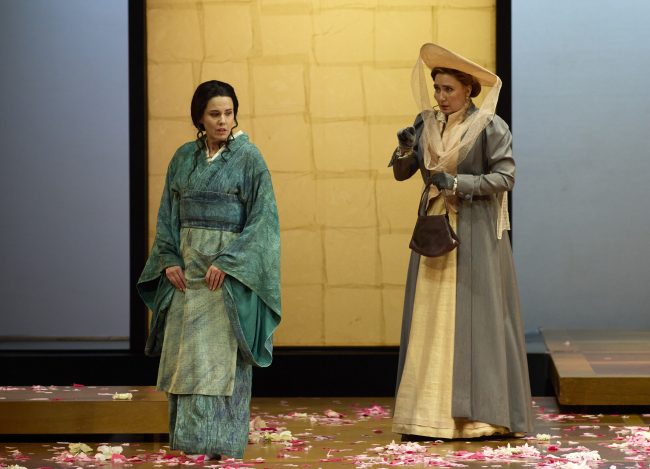
But it is hard to discuss Madama Butterfly without mentioning the politics of the time (1904) and the modern sensibility that struggles to reconcile the behaviour of Pinkerton. Despite Puccini’s best efforts to make Pinkerton more empathic, and Oxenbould’s interpretation to achieve the same (listen to the Matthew Barclay interview below), to contemporary audiences he comes across as selfish, duplicitous and weak. In fact there is a tradition where audiences boo Pinkerton during the curtain call and there was some faint booing amongst the adulation for Diego Torre who seemed to accept that as part of the role. Interestingly it was the character of his American wife, Kate (Jane Eade) who showed some backbone as the only character with the courage to actually talk honestly to Butterfly. I can only imagine given the times, that Kate could have been a suffragette.
Puccini researched Japanese music to give the opera some authenticity, despite the fact that no-one from the original 1904 production ever visited Japan. It is interesting to note that both Puccini, and Gilbert and Sullivan in the Mikado, quote the Japanese Imperial March, Miya Sama.
But ultimately Madama Butterfly is not about politics, it is a love story and a tragedy. Puccini’s true genius is his ability to express love in the most moving and poetically musical way. Every time I hear Vogliatemi bene at the end of Act One I am brought to tears, and Guanquan Yu and Diego Torre gave a three tissue performance.
A worthy start to the 2026 season, Madama Butterfly runs until 25th March.
You can listen to a recent interview with Matthew Barclay below:
Share "Review: Madama Butterfly"
Copy


